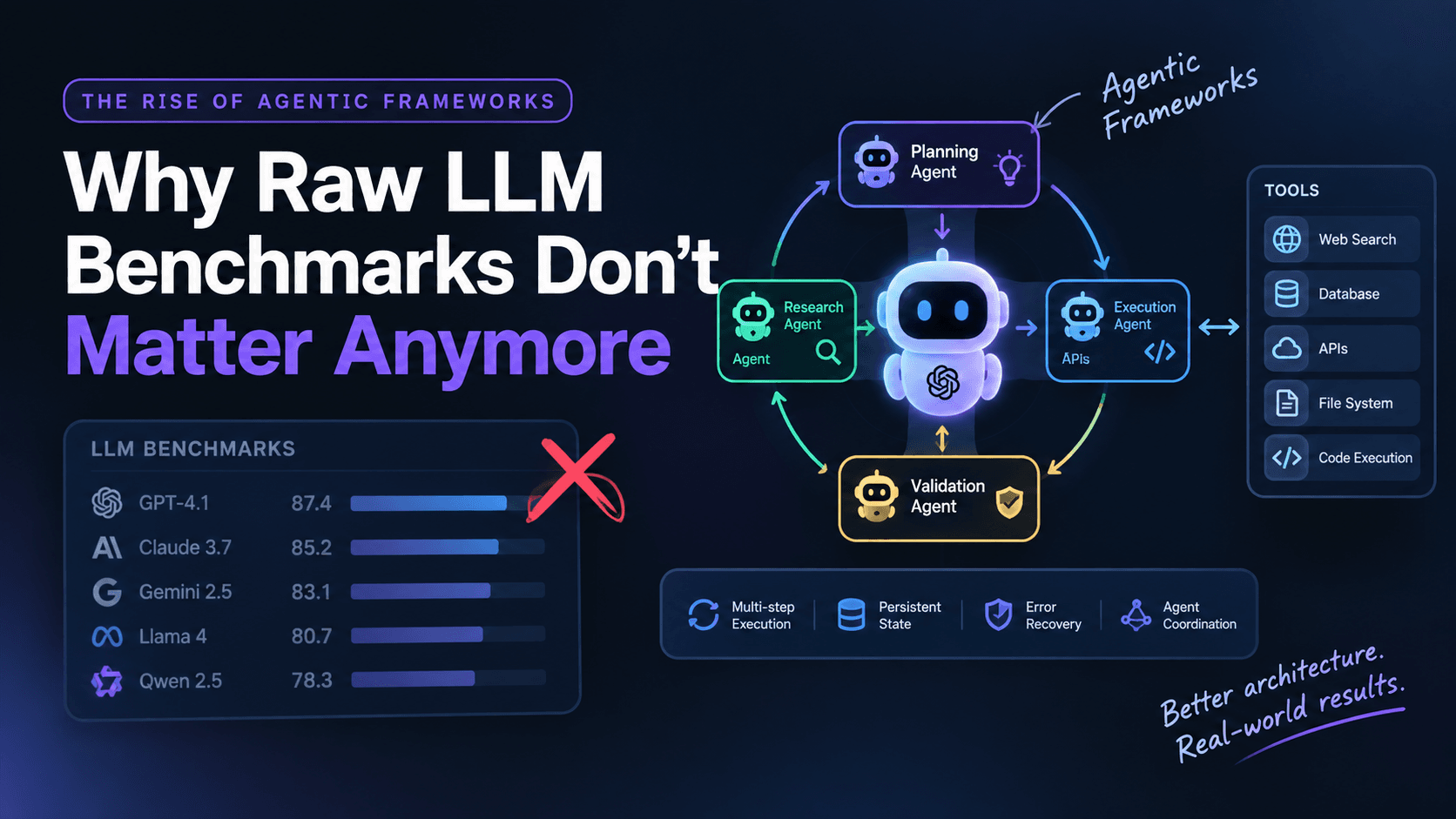
The Rise of Agentic Frameworks: Why Raw LLM Benchmarks Don't Matter Anymore
For the better part of three years, the AI industry treated benchmark leaderboards like quarterly earnings reports. Every time a lab shipped a new model, the same ritual played out: a chart comparing MMLU, GPQA, or SWE-bench scores, a few percentage points of movement, and a wave of headlines declaring a new "state of the art." That ritual is losing its meaning. Teams that ship production AI systems in 2026 are discovering that the model powering their application is rarely the reason it succeeds or fails. The deciding factor is almost always the architecture wrapped around the model — how work gets split across subagents, how state persists across steps, and how failures get contained before they cascade.
This shift has a name: the rise of agentic frameworks. And it explains why two teams using the exact same underlying model can produce wildly different results, while two teams using different models but similar orchestration patterns often converge on similar outcomes.
The Benchmark Trap: What Static Evals Don't Measure
Raw LLM benchmarks test something narrow and artificial: a single model, given a single prompt, producing a single response, graded against a fixed answer key. That setup tells you almost nothing about how a model behaves when it's:
- Operating inside a loop that runs for twenty, fifty, or two hundred steps
- Sharing partial results with other agents that have their own context windows
- Recovering from a tool call that failed halfway through
- Reasoning about a task where the "correct" output isn't known in advance
Anthropic's own engineering team has been explicit about this gap. In their write-up on building effective agents, they draw a hard architectural line between workflows — where LLMs and tools are orchestrated through predefined code paths — and agents, where the model dynamically directs its own process and tool use over multiple turns. A benchmark score describes the model's behavior in the first category. Almost none of the economic value being built in 2026 lives there anymore.
This is also why model comparison charts have started to feel disconnected from what practitioners actually experience. A model that scores marginally higher on a static reasoning benchmark can still perform worse in a live agentic pipeline if it burns context faster, hallucinates tool arguments more often under long-horizon pressure, or handles ambiguous handoffs poorly. The benchmark measures intelligence in isolation. Production systems measure reliability under coordination.
What Actually Changed: From Single Calls to Orchestrated Systems
The practical unit of AI development has moved. It used to be "which model do I call." Now it's "how do I structure the system that calls the model, potentially many times, potentially with several models running in parallel, each holding a different slice of the problem."
This shift became impossible to ignore after Anthropic published its account of building a multi-agent research system for Claude's Research feature. The architecture is deceptively simple to describe: a lead agent breaks a query into independent subtasks, spins up subagents that investigate each piece in parallel with their own context windows, and then synthesizes the distilled findings into a final answer. The result, per Anthropic's internal evaluation, was a substantial performance improvement over a single agent handling the same query sequentially — not because the underlying model got smarter, but because the problem was restructured to match how the model actually reasons well: in short, focused bursts rather than one long unbroken chain of thought.
That's the core insight driving agentic frameworks: decomposition beats scale. A task that would overwhelm a single context window, or drift off-track over a long single-agent run, becomes tractable when it's split into bounded, independently verifiable subtasks. Anthropic's own follow-up guidance on when to use multi-agent systems is careful to note this isn't a default — orchestration adds cost and coordination overhead, and it only pays off when a task genuinely decomposes into parallel, independent threads. Bolting a multi-agent architecture onto a task that's actually sequential just adds latency and token spend for no benefit.
Multi-Subagent Coordination: The New Performance Lever
If decomposition is the strategy, subagent coordination is the mechanism. A few patterns have emerged as the working vocabulary of agentic system design:
Orchestrator–worker. A central planning agent decomposes a goal, delegates pieces to specialized worker agents, and reassembles their outputs. This is the pattern behind Claude's research architecture and behind most coding agents that fan out across a large codebase — one worker per module, one reviewer that checks the combined diff.
Evaluator–optimizer loops. One agent generates a candidate solution; a second agent scores it against explicit criteria and returns feedback; the loop repeats until the output clears a quality bar. This pattern is especially effective for tasks with a verifiable success signal, like passing a test suite.
Parallel exploration with synthesis. Multiple agents investigate different angles of an open-ended problem simultaneously — mirroring how a small research team would split up a literature review — and a final pass compresses their findings into one coherent output.
None of these patterns require a better model. They require better task decomposition, clear ownership boundaries between agents, and a synthesis step that doesn't lose information in translation. Anthropic's guidance on the Claude Agent SDK makes a related point about tool design: because tools sit prominently in an agent's context window, how they're scoped and named directly shapes what actions the agent even considers taking. The same discipline applies one level up — how you scope a subagent's responsibility shapes what that subagent is capable of getting right.
This is a genuinely different skill from prompt engineering a single call. It looks more like systems design: defining interfaces, managing boundaries of responsibility, and building in checkpoints where a human — or another agent — can catch a mistake before it propagates.
State Management: The Quiet Bottleneck
Coordination gets most of the attention, but state is where agentic systems actually break in production. An agent that loses track of what it already tried, what a user already confirmed, or what a previous subagent already concluded doesn't just underperform — it repeats work, contradicts itself, or takes an action twice.
This is why frameworks built around explicit state graphs, rather than a single running conversation, have become the default substrate for serious agent deployments. LangGraph, for instance, models an agentic application as a graph of nodes with a defined, typed state object passed between them, plus built-in checkpointing so that a run's state is durably saved after every step. That persistence layer is what makes it possible to pause a long-running agent for human review, resume it after a crash, or rewind to an earlier point and try a different branch — none of which is possible if state only lives inside a single prompt's context window.
Framing this as "just memory" undersells it. Good state management is what turns an agent from a stateless function you call repeatedly into a system that can:
- Survive a process restart mid-task without losing progress
- Support human-in-the-loop approval before an irreversible action
- Give multiple subagents a consistent, shared view of what's already been decided
- Provide an audit trail for debugging or compliance review
Teams that treat state as an afterthought — stuffing everything back into a growing prompt — hit a ceiling fast. Long-running agents drift, forget earlier constraints, or silently drop instructions once the context window fills. The fix isn't a bigger context window; it's a state model that decides what persists, what gets summarized, and what gets discarded.
If your agent's pipeline touches a vector store or retrieval layer as part of its working memory, the failure modes compound quickly — a related breakdown of how data ingestion mistakes silently corrupt vector databases is worth reading alongside this, since bad chunking or missing metadata upstream will produce exactly the kind of inconsistent agent behavior that looks like a "model problem" but isn't one.
Standardized Interfaces: Why Protocols Matter More Than Model Choice
Multi-agent coordination and durable state only scale if agents and tools can talk to each other in a predictable way. This is the practical reason the Model Context Protocol (MCP) gained traction so quickly after its release: it standardizes how an application exposes tools, resources, and prompts to a model, so the same tool integration works across different agent frameworks and different model providers without custom glue code for each combination.
The pattern echoes something the industry already went through with inference APIs. Once one interface format became the de facto standard, competing frameworks built on top of it rather than around it — a dynamic explored in why LLM inference frameworks converged on a single API format. Protocol convergence is what lets an agentic framework swap the underlying model without rewriting the orchestration layer, which is precisely why the framework — not the model — has become the more durable investment.
OpenAI's own guidance for teams building agent systems makes a parallel argument in its practical guide to building agents: start with a single agent, well-scoped tools, and clear instructions, and only introduce multi-agent orchestration once a task's complexity genuinely demands it. That's not a model recommendation. It's an architecture recommendation — reinforcing that the meaningful design decisions now happen above the model layer, not inside it.
Why This Beats Chasing Monolithic Model Upgrades
None of this argues that model quality is irrelevant — a materially weaker model will still underperform inside any architecture. But the marginal return on chasing the next point of benchmark improvement has flattened, while the marginal return on better orchestration has not. A few reasons this trade-off keeps tipping toward architecture:
Diminishing returns on raw capability. Once a model is reliably good enough to follow instructions, call tools correctly, and reason over a few thousand tokens of context, additional raw capability produces smaller gains than restructuring how that capability gets applied to the task.
Model-agnostic durability. A well-designed agentic framework — clear subagent boundaries, durable state, standardized tool interfaces — survives a model swap. Teams that built their entire system around one model's quirks have to rebuild when they switch; teams that built a framework just point it at a new endpoint.
Failure containment. In a monolithic single-call system, a mistake is the whole answer. In a properly bounded multi-agent system, a mistake is contained to one subagent's output, which can be caught by an evaluator step or a human checkpoint before it reaches the final result. This is a structural reliability advantage no model upgrade can replicate on its own.
Cost transparency. Multi-agent systems are not free — Anthropic has been candid that orchestrated research runs can consume many times the tokens of a single chat exchange. But that cost is visible and controllable at the architecture level (how many subagents, how much parallelism), whereas the cost of an unreliable monolithic system — wrong answers reaching users — is often invisible until it's already caused damage.
This mirrors a broader trend already documented in how agentic coding reshaped software development in 2026: the bottleneck didn't disappear when models got better at writing code — it moved to review, verification, and orchestration. The same pattern is repeating across every domain agentic systems touch.
A Practical Framework for Evaluating Your Stack
Before adopting an agentic architecture, it's worth checking whether the problem actually calls for one. A few questions help make that call:
- Does the task decompose into genuinely independent subtasks? If the steps are strictly sequential and each depends entirely on the last, a single well-designed agent with prompt chaining may outperform a multi-agent setup at a fraction of the cost.
- Is there a verifiable success signal? Tasks with clear pass/fail criteria (tests passing, a schema validating, a number matching) are strong candidates for evaluator-optimizer loops.
- Does the workflow need to survive interruption? If a run might take minutes or hours, or needs human approval mid-process, durable state and checkpointing aren't optional — they're the difference between a usable system and a fragile demo.
- Can tool access be scoped tightly per agent? Broad, undifferentiated tool access invites subagents to take actions outside their intended lane. Narrow, well-named tools reduce that risk significantly.
- What does a failure cost? High-stakes actions — financial transactions, irreversible deletions, anything customer-facing — justify the overhead of human-in-the-loop checkpoints regardless of how capable the underlying model is.
Teams that work through this checklist before reaching for the newest model release tend to end up with systems that are cheaper to run, easier to debug, and more resilient to the next model transition — which, given the pace of releases in this industry, is not a hypothetical concern.
The Road Ahead
Benchmark scores will keep being published, and they'll keep being a useful — if narrow — signal of raw capability. But the center of gravity in AI engineering has already moved to the layer above the model: how tasks get decomposed across subagents, how state persists and gets audited, and how standardized protocols let that architecture survive a model swap without a rebuild. Organizations that internalize this early are the ones building systems that keep improving every time a better model becomes available — because the architecture around the model was the durable investment all along.
Frequently Asked Questions
Do agentic frameworks replace the need for good models entirely?
No. A capable model is still a prerequisite — orchestration cannot compensate for a model that consistently fails at basic instruction-following or tool-call formatting. The point is that once a model clears that baseline, further gains come more reliably from better task decomposition and state management than from marginal model upgrades.
Is multi-agent orchestration always more effective than a single agent?
No, and treating it as a default is a common mistake. Multi-agent systems add coordination overhead and token cost. They earn their keep specifically on tasks that decompose into independent, parallelizable subtasks — sequential or narrowly scoped tasks are often better served by a single well-instructed agent.
What's the single biggest failure mode in production agentic systems?
Poor state management. Agents that lose track of prior decisions, retry completed work, or drift after long context windows fill up tend to fail in ways that look like "the model is bad" but are actually architecture problems — solvable with durable state and checkpointing rather than a different model.