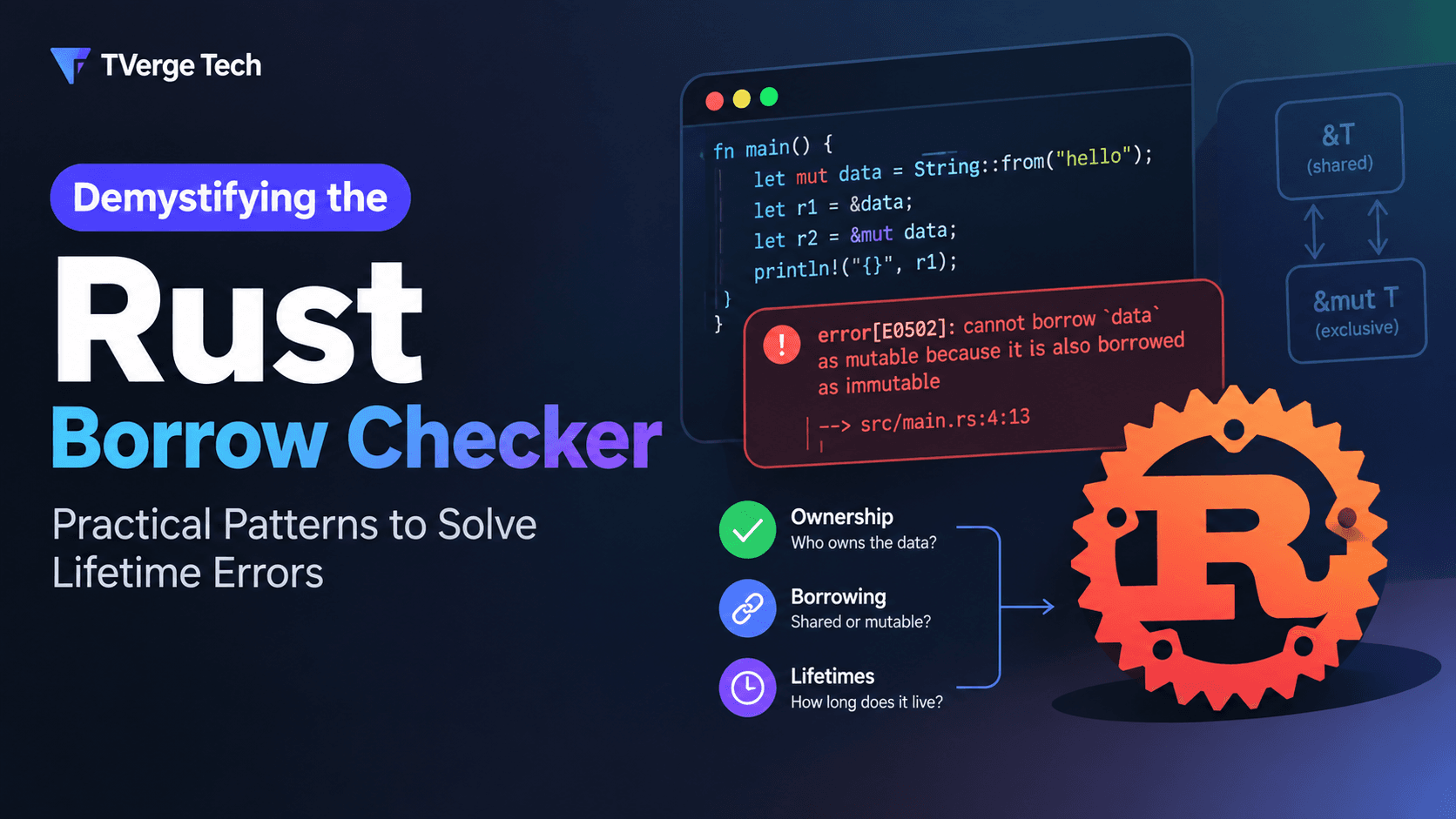
Demystifying the Rust Borrow Checker: Practical Patterns to Solve Lifetime Errors
If you're learning Rust, there's a good chance you've already met "the borrow checker" — usually in the least friendly way possible: a wall of red text, a cannot borrow as mutable error, and a nagging feeling that the compiler is fighting you instead of helping you. This is one of the most common reasons developers bounce off Rust in their first few weeks, even though the underlying rules are learnable and, once internalized, genuinely make you a better systems programmer in any language.
This guide breaks the borrow checker down from first principles, then walks through the specific error patterns that trip people up most — dangling references, struct lifetimes, mutable/immutable borrow conflicts, iterator invalidation, self-referential structs, and closures — with concrete, before-and-after code for each one. By the end, you won't just know how to silence an error message; you'll understand why the compiler raised it and which fix actually fits your situation.
What the Borrow Checker Is Actually Doing
Rust doesn't have a garbage collector, and it doesn't require you to manually free memory the way C does. Instead, it uses a compile-time system called ownership to track exactly when a piece of memory is created and exactly when it should be cleaned up. The borrow checker is the part of the compiler that enforces the rules of that system before your program ever runs.
Three rules sit at the core of it:
- Every value in Rust has a single owner — the variable responsible for it.
- When the owner goes out of scope, the value is dropped (its memory is freed).
- You can either have one mutable reference to a value, or any number of immutable references, but never both at the same time.
That third rule is the one that generates most of the errors people call "lifetime errors," even when lifetimes in the technical sense aren't directly involved. It exists to eliminate an entire category of bugs — data races, use-after-free, and iterator invalidation — at compile time rather than at 3 a.m. in production.
Lifetimes are the mechanism the compiler uses to reason about how long a reference is valid relative to the data it points to. Every reference has an implicit lifetime; most of the time the compiler infers it silently, and you never see it. It only becomes visible in your code when the compiler can't infer it on its own — usually in function signatures or struct definitions involving references.
Ownership and Borrowing: The Two-Minute Refresher
Before tackling specific error patterns, it helps to be precise about the vocabulary, since the compiler's messages use it directly.
- Move: when you assign a non-
Copyvalue to a new variable or pass it to a function, ownership transfers. The original variable can no longer be used. - Borrow: instead of transferring ownership, you can pass a reference (
&Tfor immutable,&mut Tfor mutable) that lets code temporarily use a value without owning it. - Lifetime: the span of code during which a reference is guaranteed to be valid. Written as
'a,'b, and so on, when the compiler needs it spelled out explicitly.
fn main() {
    let s1 = String::from("hello");
    let s2 = s1; // s1 is moved into s2

    // println!("{}", s1); // ERROR: value borrowed after move
    println!("{}", s2); // fine
}
That's a move error, not strictly a lifetime error, but it's the same underlying ownership model that produces both. Once you see moves and borrows as two sides of the same rule — "only one thing is responsible for this data at a time" — the rest of the borrow checker's behavior starts to make sense.
Pattern 1: Returning a Reference to Data That No Longer Exists
This is the classic "dangling reference" error, and it's usually the first one new Rust developers hit.
fn longest_word() -> &str {
    let text = String::from("the quick brown fox");
    let word = text.split_whitespace().next().unwrap();
    word // ERROR: `text` does not live long enough
}
The function creates text locally, borrows a slice of it, and tries to return that slice. But text is dropped the moment the function ends — so the reference being returned would point at freed memory. The borrow checker refuses to compile this, which is exactly the bug it's designed to prevent.
The fix is almost always to change what you return, not to "convince" the compiler the reference is fine (it isn't). Three common options:
// Option A: return an owned String instead of a borrowed &str
fn longest_word() -> String {
    let text = String::from("the quick brown fox");
    text.split_whitespace().next().unwrap().to_string()
}

// Option B: take the input as a parameter, so the caller owns the data
fn longest_word(text: &str) -> &str {
    text.split_whitespace().next().unwrap()
}

// Option C: return an index or length instead of a reference
fn first_word_len(text: &str) -> usize {
    text.split_whitespace().next().unwrap().len()
}
Option B is worth pausing on because it introduces lifetime elision — the compiler's set of default rules for inferring lifetimes in common function signatures. Here, the returned &str is inferred to live as long as the input text reference, without you writing 'a anywhere. Elision covers most everyday functions; you only write explicit lifetimes when a signature is ambiguous enough that elision can't resolve it (for example, a function taking two reference parameters and returning one of them).
Pattern 2: Structs That Hold References
This is where lifetime annotations stop being optional and start needing your attention.
struct Excerpt {
    part: &str, // ERROR: missing lifetime specifier
}
A struct holding a reference needs a named lifetime parameter, because the compiler must be able to guarantee that the struct itself never outlives the data it borrows from.
struct Excerpt<'a> {
    part: &'a str,
}

fn main() {
    let novel = String::from("Call me Ishmael. Some years ago...");
    let first_sentence = novel.split('.').next().unwrap();

    let excerpt = Excerpt { part: first_sentence };
    println!("{}", excerpt.part);
}
Read <'a> as: "this struct is generic over some lifetime 'a, and the part field is only valid as long as 'a is." The compiler then checks, at every place Excerpt is created or used, that the source data (novel) outlives the Excerpt instance. If you tried to keep the Excerpt around after novel was dropped, you'd get an error again — which is the whole point.
Practical pattern: if you find yourself adding lifetime parameters to more and more structs just to avoid an allocation, stop and ask whether an owned String (instead of &'a str) or a reference-counted pointer (see Pattern 6) would simplify the design. Borrowed structs are great for short-lived, read-only views into data (parsers, tokenizers, zero-copy deserialization), but they're a poor fit for anything that needs to be stored, passed around asynchronously, or outlive a narrow scope.
Pattern 3: Mutable and Immutable Borrow Conflicts
This is the error message most people quote when they complain about "fighting the borrow checker":
fn main() {
    let mut scores = vec![10, 20, 30];
    let first = &scores[0];
    scores.push(40); // ERROR: cannot borrow `scores` as mutable
                      // because it is also borrowed as immutable
    println!("{}", first);
}
first is an immutable borrow of scores. Calling scores.push(40) requires a mutable borrow — but Vec::push can reallocate the underlying buffer, which would leave first pointing at freed memory. The compiler isn't being pedantic; this is a real use-after-free bug in languages that allow it silently.
Fix — shrink the borrow's scope. Since Rust 2018, the compiler uses non-lexical lifetimes (NLL), meaning a borrow ends at its last use, not at the end of the enclosing block. So the fix is often just reordering:
fn main() {
    let mut scores = vec![10, 20, 30];
    let first = &scores[0];
    println!("{}", first); // last use of `first` — the borrow ends here
    scores.push(40); // fine now
}
Fix — copy the value out if the type is small and cheap (Copy types like integers):
fn main() {
    let mut scores = vec![10, 20, 30];
    let first = scores[0]; // copies the i32, no borrow held
    scores.push(40);
    println!("{}", first);
}
Fix — split the borrow when you need to mutate different parts of the same structure at once. Slices have dedicated methods for exactly this:
fn main() {
    let mut values = [1, 2, 3, 4];
    let (left, right) = values.split_at_mut(2);
    left[0] += 10;
    right[0] += 100;
}
split_at_mut returns two disjoint mutable slices; the compiler can verify they don't overlap, so both borrows are allowed simultaneously.
Pattern 4: Iterator Invalidation
A close cousin of Pattern 3, and a frequent source of confusion for developers coming from languages that allow mutation during iteration (with runtime consequences ranging from silent bugs to ConcurrentModificationException).
fn main() {
    let mut numbers = vec![1, 2, 3, 4, 5];

    for n in &numbers {
        if *n % 2 == 0 {
            numbers.retain(|&x| x != *n); // ERROR: cannot borrow as mutable
        }
    }
}
for n in &numbers holds an immutable borrow for the whole loop. Any attempt to mutate numbers inside that loop is rejected — correctly, since mutating a Vec while iterating over it (e.g., removing elements) is a well-known source of skipped elements or panics in other languages.
Fix — use a retain/filter pass instead of mutating mid-iteration:
fn main() {
    let mut numbers = vec![1, 2, 3, 4, 5];
    numbers.retain(|&x| x % 2 != 0); // keep only odd numbers
    println!("{:?}", numbers);
}
Fix — collect the changes first, apply them after:
fn main() {
    let mut numbers = vec![1, 2, 3, 4, 5];
    let to_remove: Vec<i32> = numbers.iter().filter(|&&n| n % 2 == 0).copied().collect();

    for n in to_remove {
        numbers.retain(|&x| x != n);
    }
}
This pattern — read fully, then mutate — comes up constantly in Rust and is worth internalizing as a default habit rather than a workaround.
Pattern 5: Self-Referential Structs
This is the pattern that trips up even experienced Rust developers, because the honest answer is: plain safe Rust cannot express a struct that holds both a value and a reference to that same value.
struct SelfRef {
    value: String,
    pointer: &str, // wants to point into `value` — not expressible safely
}
The compiler can't assign this a valid lifetime, because as soon as the struct moves (and Rust structs move by default — during a return, a Vec reallocation, etc.), the reference would point at the old memory location while value moved to a new one.
You have a few legitimate paths forward, depending on what you're actually trying to do:
- Store an index instead of a reference. If
pointeris meant to reference a position withinvalue, store ausizeoffset and re-derive the&stron demand with&self.value[self.pointer..]. - Use
Rc<T>orArc<T>so both fields own a reference-counted handle to the same heap allocation, rather than one field borrowing from the other (see Pattern 6). - Reach for a purpose-built crate like
ouroborosorself_cell, which generate the unsafe scaffolding for you behind a safe API, if the self-referential shape is unavoidable in your design. - Reconsider the data model. In most real codebases, a "self-referential struct" request is a sign that two independent structs, connected by an ID or index (as in an arena or slotmap pattern), would be simpler and avoid the problem entirely.
The takeaway: this isn't a gap in your understanding of lifetimes — it's a genuine limitation of the ownership model, and the standard response is to restructure the data rather than to search for lifetime syntax that "makes it work."
Pattern 6: When Borrowing Doesn't Fit — Rc, Arc, and RefCell
Sometimes the right answer isn't a clever lifetime annotation at all — it's stepping outside strict compile-time borrow checking for the specific piece of data that needs shared ownership.
Rc<T>(Reference Counted) lets multiple parts of your program share ownership of the same heap value in a single-threaded context. Cloning anRcincrements a counter rather than copying the underlying data; the value is dropped only when the lastRcpointing to it is dropped.Arc<T>(Atomic Reference Counted) is the thread-safe equivalent, used when the shared value needs to cross thread boundaries.RefCell<T>moves Rust's "one mutable or many immutable" rule from compile time to run time. It allows interior mutability — mutating a value even through a shared, immutable-looking reference — by panicking if the borrow rules are violated at runtime instead of catching it at compile time.
use std::rc::Rc;
use std::cell::RefCell;

#[derive(Debug)]
struct Node {
    value: i32,
    children: Vec<Rc<RefCell<Node>>>,
}

fn main() {
    let leaf = Rc::new(RefCell::new(Node { value: 3, children: vec![] }));
    let root = Rc::new(RefCell::new(Node { value: 1, children: vec![Rc::clone(&leaf)] }));

    leaf.borrow_mut().value += 10; // interior mutability via RefCell
    println!("{:?}", root.borrow().children[0].borrow().value);
}
The common combination Rc<RefCell<T>> (or Arc<Mutex<T>> in multithreaded code) shows up constantly in graphs, trees with parent pointers, and shared mutable state — exactly the shapes that plain ownership and borrowing can't express cleanly. Reaching for it isn't "giving up" on the borrow checker; it's using the tool the standard library provides for the cases the compile-time model was never meant to solve.
Pattern 7: Closures That Capture References
Closures add a layer of inference on top of everything above, and lifetime errors involving closures are often really about how a closure captures its environment.
fn make_adder(x: i32) -> impl Fn(i32) -> i32 {
    move |y| x + y // `move` forces the closure to take ownership of `x`
}
Without move, the closure would try to borrow x from its enclosing scope. Since make_adder returns the closure, x would need to outlive the function — but x is a parameter that only lives for the duration of the call, so the compiler forces the closure to own its own copy with move.
A more common variant:
fn main() {
    let data = vec![1, 2, 3];
    let mut closures: Vec<Box<dyn Fn() -> i32>> = vec![];

    for i in 0..data.len() {
        let d = &data; // borrow, not move
        closures.push(Box::new(move || d[i])); // ERROR-prone without care
    }
}
If you need a closure to outlive the current scope (stored in a Vec, returned from a function, spawned onto a thread), default to move and let the closure take ownership of whatever it needs — cloning beforehand if the original value still needs to be used afterward.
fn main() {
    let data = Rc::new(vec![1, 2, 3]);
    let mut closures: Vec<Box<dyn Fn() -> i32>> = vec![];

    for i in 0..data.len() {
        let data = Rc::clone(&data);
        closures.push(Box::new(move || data[i]));
    }
}
Cloning an Rc is cheap (a pointer copy and a counter increment), which makes this pattern the standard fix when several closures need shared access to the same data.
Pattern 8: Lifetimes in Async Code
Async Rust adds one more wrinkle: an async fn desugars into a state machine (a Future) that may be polled across multiple points in time, on potentially different stack frames. That changes what "how long does this reference live" means in practice.
async fn process(data: &str) {
    some_async_operation(data).await;
}
This compiles fine on its own, but problems appear when you try to spawn such a future onto an executor (e.g., tokio::spawn), which typically requires the future to be 'static — meaning it can't borrow from anything outside itself, since the executor can't guarantee the borrowed data will still be alive when the task actually runs.
async fn process(data: String) {
    // owns its data — safe to spawn independently
    some_async_operation(&data).await;
}

fn main() {
    let owned = String::from("payload");
    tokio::spawn(process(owned)); // no lifetime conflict
}
Rule of thumb for async code: functions and structs that will be spawned as independent tasks should own their data (String, Vec<T>, Arc<T>) rather than borrow it. Reserve borrowed parameters for async functions that are .awaited directly within the same scope as their data, not handed off to a separate task or thread.
A Working Checklist for Debugging Lifetime Errors
When the compiler produces a lifetime or borrow error, work through these questions roughly in order:
- Is this actually a dangling reference? Am I returning or storing a reference to something that's about to be dropped? If so, return an owned value instead.
- Am I holding a borrow longer than I need to? Since NLL, most conflicts disappear if the immutable borrow's last use happens before the mutable operation. Reorder the code first.
- Do I actually need a reference here, or would an owned value (or a cheap
Copy) be simpler? Small types (integers, small structs implementingCopy) are often cheaper to copy than to fight a borrow over. - Am I mutating a collection while iterating it? Switch to
retain/filter, or collect the targets first and apply changes in a second pass. - Does this data genuinely need multiple owners, or shared mutability? If yes, reach for
Rc/Arc(andRefCell/Mutexif mutation is needed) rather than trying to express it with borrows alone. - Is this a self-referential structure? Store an index or ID instead of a raw reference, or use a crate designed for the self-referential case.
- Is this closure or async task going to outlive the current scope? Default to
moveand own the data, especially before spawning threads or tasks.
Running through this list turns "the borrow checker won't let me" into a specific, answerable design question almost every time.
Tooling That Makes Lifetimes Easier to Reason About
rust-analyzer(the language server most editors use) inlines inferred types and lifetimes directly in your editor, which demystifies a huge share of "invisible" lifetime elision the compiler applies silently.cargo clippycatches a wide range of borrow-related anti-patterns — unnecessary clones, borrows that could be simplified, and closures that capture more than they need — before they become larger structural problems.cargo checkgives you the borrow checker's verdict without a full compile, which makes it worth running constantly while refactoring lifetime-heavy code.- The compiler's own error messages are unusually good in Rust — they typically suggest the exact fix (adding a lifetime parameter, adding
move, or restructuring a borrow). Reading the full message and the suggested fix before reaching for Stack Overflow will resolve the majority of cases directly.
Closing Thoughts
The borrow checker isn't an obstacle bolted onto Rust — it's the mechanism that lets Rust guarantee memory safety without a garbage collector, and every error it raises corresponds to a real bug pattern that other languages allow to reach production. Once the patterns above become familiar, lifetime errors stop feeling like arbitrary compiler pedantry and start reading as precise, useful feedback about the actual structure of your data's ownership.
The practical shortcut worth remembering: when a borrow error appears, don't reach for lifetime syntax as the first move. Ask whether the code actually needs a borrow at all, whether the borrow's scope can shrink, or whether the data needs shared ownership instead — the fix is almost always one of those three, not a more elaborate lifetime annotation.
Further Reading (Official Documentation)
- The Rust Programming Language — Understanding Ownership
- The Rust Programming Language — Validating References with Lifetimes
- The Rustonomicon — Ownership Based Resource Management
- Rust Reference — Lifetime Elision
- std::rc::Rc — Standard Library Documentation
- std::cell::RefCell — Standard Library Documentation
- std::sync::Arc — Standard Library Documentation
- Rust By Example — Scoping Rules