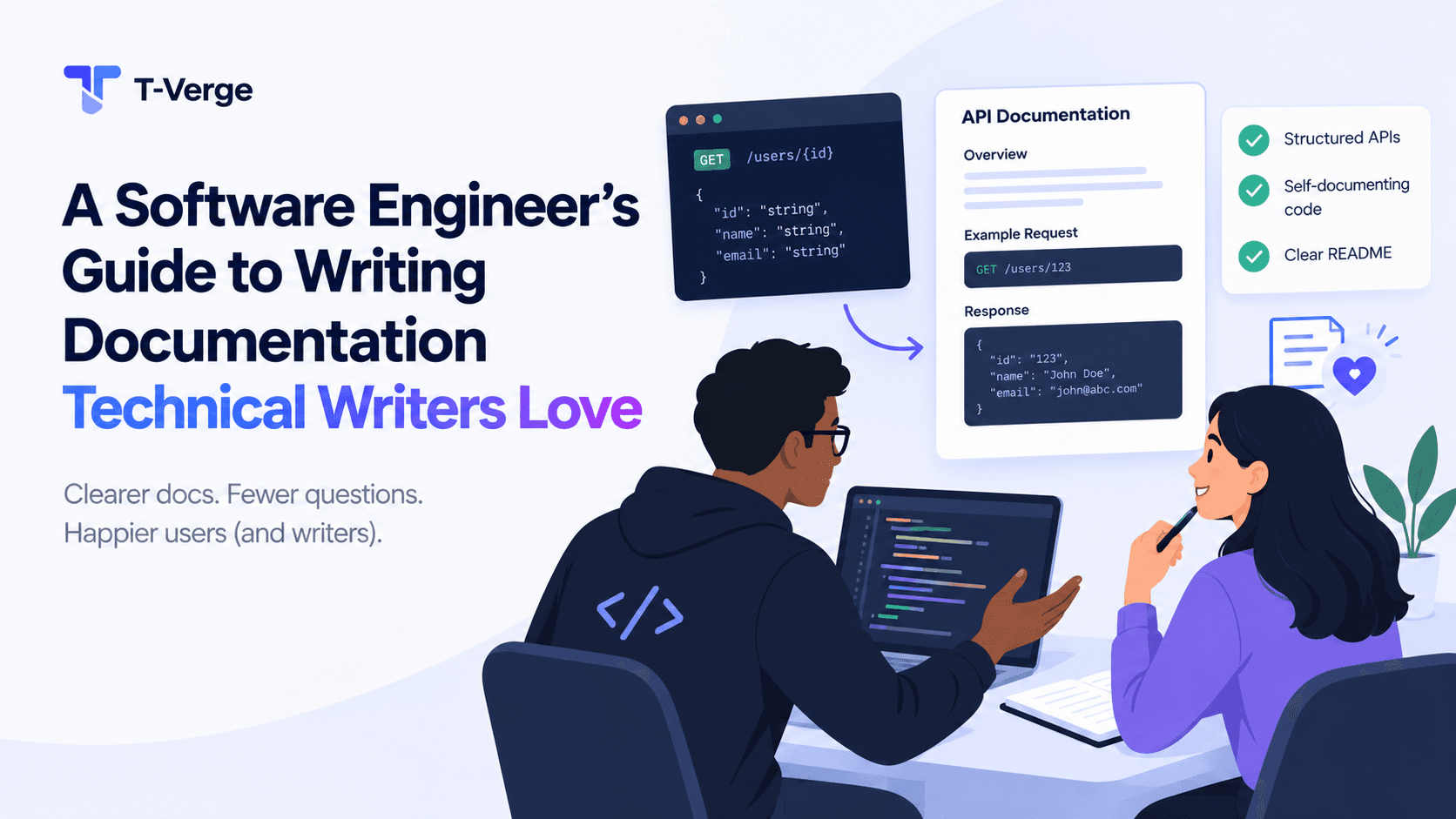
A Software Engineer's Guide to Writing Documentation Technical Writers Love
Most engineers don't dislike documentation — they dislike documentation that fights them. A README that goes stale the week after it's written. An API reference that lists parameters but never shows what a real request looks like. Code so cryptic that a comment block is the only thing standing between a new hire and total confusion.
Technical writers, meanwhile, are often handed half-finished specs, undocumented edge cases, and endpoints that changed three sprints ago without anyone updating the notes. The gap between "engineer-written" and "writer-ready" documentation isn't about talent — it's about structure, consistency, and a few habits that make documentation something writers can actually build on instead of reverse-engineer.
This guide covers three areas where that gap shows up most: structured API endpoint documentation, self-documenting code, and README files that don't require a Slack thread to understand.
Why Documentation Quality Is an Engineering Problem, Not Just a Writing Problem
Documentation debt behaves exactly like technical debt. It compounds. An undocumented parameter today becomes a support ticket next month and a breaking change nobody catches in production next quarter.
The Google Developer Documentation Style Guide frames good documentation as a product decision, not an afterthought — consistency in terminology, voice, and structure is treated with the same rigor as consistency in an API's design. That mindset matters because documentation isn't a translation layer that happens after engineering work; the clearest docs come from engineers who structure their code and APIs in ways that are already close to self-explanatory before a writer ever touches them.
Part 1: Writing Structured API Endpoint Documentation
The single biggest lever for API documentation quality is structure — not prose. Technical writers can polish tone and clarity, but they can't invent a request schema you never defined.
Start With a Machine-Readable Contract
The most reliable way to keep API documentation accurate is to stop writing it by hand for every endpoint. Define your API using the OpenAPI Specification, and generate reference documentation from that contract using tools like Swagger UI or Redoc. This gives writers and engineers a single source of truth instead of two documents that quietly drift apart.
An OpenAPI-described endpoint should include, at minimum:
- HTTP method and path —
POST /v1/users, not just "the users endpoint" - Authentication requirements — which header, token type, and scope
- Request schema — every field, its type, whether it's required, and valid value ranges, ideally defined with JSON Schema
- Response schema — for both success and error cases
- Status codes — not just 200 and 500, but every code your API actually returns and what triggers it
- Rate limits and pagination behavior, if applicable
Show Real Requests and Responses
Parameter tables tell a writer what a field is. Examples tell them — and every developer reading the docs — how it's actually used. Look at how Stripe's API reference pairs every endpoint with a live, copy-pasteable request in multiple languages alongside the exact JSON response. That pairing is what makes API docs usable rather than just accurate.
A well-documented endpoint should include:
POST /v1/orders
Authorization: Bearer <token>
Content-Type: application/json

{
  "customer_id": "cus_12345",
  "items": [{ "sku": "SKU-001", "quantity": 2 }],
  "currency": "usd"
}
Followed immediately by the response shape, including a realistic error example:
{
  "error": {
    "code": "invalid_currency",
    "message": "Currency 'usd' is not enabled for this account."
  }
}
If your API returns malformed or unexpected JSON under certain failure conditions, it's worth linking to a debugging resource that shows engineers how to trace the problem — this step-by-step guide to debugging JSON parse errors is a good example of the kind of practical, mechanism-level reference that belongs next to an error-code table.
Document the "Why," Not Just the "What"
Structural convergence across an ecosystem is itself worth documenting. If your API mirrors an existing standard — for example, many inference and chat APIs today expose endpoints that mirror OpenAI's /v1/chat/completions shape — say so explicitly, and explain the deviations. This breakdown of why LLM inference frameworks converged on OpenAI's API format is a useful reference for understanding why consistency with existing conventions reduces the documentation burden for everyone downstream.
Versioning and Deprecation
Every endpoint document should state:
- The API version it belongs to
- Whether it's stable, beta, or deprecated
- A deprecation timeline and migration path, if applicable
Follow Semantic Versioning for your API versions, and keep a changelog formatted according to the Keep a Changelog convention so both engineers and writers can track what changed, when, and why.
Part 2: Writing Self-Documenting Code
Technical writers can only document what's legible to them in the first place. Self-documenting code doesn't eliminate the need for external documentation — but it drastically reduces the guesswork required to produce it.
Naming Is Documentation
A function called process(data) documents nothing. A function called normalizePhoneNumberToE164(rawInput) documents its purpose in the signature alone. Favor:
- Descriptive function and variable names over abbreviations
- Consistent naming patterns across a codebase (
getUser,getOrder,getInvoice— notfetchUser,retrieveOrder,loadInvoice) - Boolean names that read as questions —
isActive,hasPermission,canRetry
Use Docstrings and Type Annotations, Not Just Comments
Inline comments explain why something unusual is happening. Docstrings and type systems explain what a function does and what it expects, and — critically — they can be extracted automatically into reference documentation.
- In Python, follow PEP 257 docstring conventions, and use type hints so tools like Sphinx can generate accurate reference pages without a human re-typing every parameter.
- In JavaScript/TypeScript, use JSDoc annotations consistently, especially on exported functions and public API surfaces.
- In Java, follow standard Javadoc conventions for public methods and classes.
python
def normalize_phone_number(raw_input: str, region: str = "US") -> str:
    """Convert a raw phone number string into E.164 format.

    Args:
        raw_input: The unformatted phone number as entered by the user.
        region: ISO 3166-1 alpha-2 country code used to resolve the
            national dialing prefix when none is present in raw_input.

    Returns:
        The phone number formatted as an E.164 string, e.g. "+14155552671".

    Raises:
        ValueError: If raw_input cannot be parsed as a valid phone number.
    """
This single docstring gives a technical writer everything needed to document the function correctly without asking the author a follow-up question.
Comment the "Why," Never the "What"
A comment that restates the code adds noise:
python
# increment counter by one
counter += 1
A comment that explains a non-obvious decision adds value:
python
# Retrying up to 3 times because the upstream payment gateway
# intermittently returns 502s under load; see incident INC-2291.
retry(call_payment_gateway, max_attempts=3)
Keep Code and Documentation Physically Close
Documentation that lives far from the code it describes goes stale fastest. Favor doc comments in the source file, README sections colocated with the module they describe, and a docs-as-code workflow where documentation changes are reviewed in the same pull request as the code change. This is also where memory-related bugs and other subtle failures tend to get documented poorly — see how this breakdown of a Node.js memory leak ties root-cause explanation directly to the code paths involved, rather than describing the symptom in isolation.
Part 3: Writing README Files That Don't Need a Translator
A README is often the first — and sometimes only — documentation a new contributor or user will read. It needs to answer questions in the order people actually ask them.
The Structure That Works
- Project title and one-line description — what this project does, in plain language
- Badges — build status, version, license (optional, but common in open-source projects)
- Why it exists — the problem it solves, in two or three sentences
- Installation — the exact commands, not a description of them
- Quick start / usage example — a minimal working example a reader can copy-paste and run immediately
- Configuration — environment variables, config files, defaults
- API reference or link to it — don't duplicate full API docs in the README; link out
- Contributing guidelines — or a link to
CONTRIBUTING.md - License
Markdown Hygiene
Since almost every README is written in Markdown, follow the CommonMark specification so formatting renders consistently across GitHub, GitLab, documentation generators, and IDEs. A few habits that separate clean READMEs from messy ones:
- Use fenced code blocks with language identifiers (
```bash,```python) so syntax highlighting works everywhere - Keep heading levels sequential — don't jump from
##to#### - Use relative links for files within the repo, and absolute URLs for external resources
- Run your README through a markdown linter (such as
markdownlint) as part of CI, the same way you lint code
Write the Quick Start for a Reader Who Knows Nothing
The most common README failure is assuming context. A good quick-start example should work for someone who has never seen the project before:
bash
git clone https://github.com/your-org/your-project.git
cd your-project
npm install
npm run dev
Followed by the smallest possible usage example — not a comprehensive tutorial, just enough to prove the thing works.
Keep It Current
A README describing a v1 API while the codebase is on v3 is worse than no README at all, because it actively misleads. Treat README updates as a required part of any pull request that changes installation steps, configuration, or the public interface — not an optional cleanup task.
Bridging the Gap With Technical Writers
The best engineering-writer collaborations share a few habits:
- Docs-as-code: documentation lives in the same repository as the code, reviewed through the same pull request process, using the same version control.
- A shared style guide: adopting an existing standard, such as the Google Developer Documentation Style Guide or the Microsoft Writing Style Guide, removes hundreds of small inconsistency debates.
- Single source of truth for API contracts: OpenAPI/JSON Schema definitions that both generate the reference docs and validate the API at runtime, so the docs can't silently drift from behavior.
- Community and process references: organizations like Write the Docs publish practical guides on documentation systems, review workflows, and information architecture that apply directly to internal engineering docs.
Conclusion
Documentation technical writers love isn't documentation that reads beautifully — it's documentation built on a foundation an engineer already got right: a well-defined API contract, code that names its own intentions, and a README that answers questions in the order a reader actually has them. Get those three things structurally sound, and the writing itself becomes the easy part.