Learn how process.nextTick, setImmediate, and timers really schedule work in the Node.js event loop, and how to tune them for predictable, starvation-free async execution.
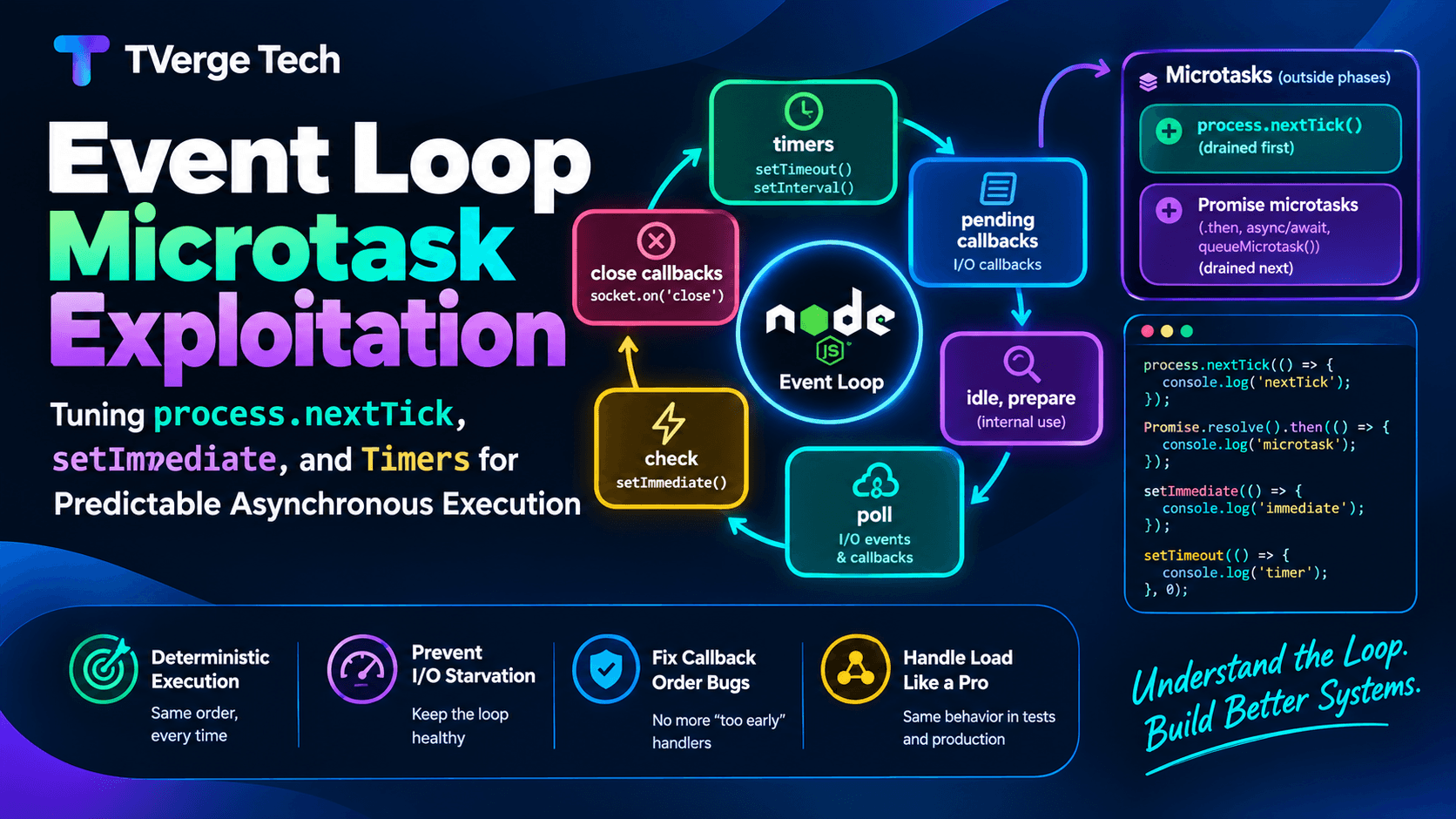
Event Loop Microtask Exploitation: Tuning process.nextTick, setImmediate, and Timers for Predictable Asynchronous Execution
If you've ever shipped a Node.js service that behaved differently in production than it did on your laptop — a callback that fired "too early," a timer that drifted under load, or a request handler that silently starved I/O — you've already met the problem this article solves. Node.js doesn't run your asynchronous code in the order you read it. It runs it in the order the event loop schedules it, across a strict sequence of phases and queues.
"Exploitation" here doesn't mean hacking the runtime. It means understanding the scheduling primitives well enough to bend them deliberately: forcing deterministic callback order, preventing I/O starvation, and making concurrency behave the same way in a load test as it does at 3 a.m. in production. That's a legitimate, well-documented part of the Node.js runtime's design, and this guide walks through it end to end.
Why "Predictable" Async Matters More Than "Fast" Async
Most performance guides optimize for throughput. Fewer talk about determinism — the guarantee that a given input produces the same execution order every time. Determinism matters because:
Race conditions in async code are rarely reproducible locally; they show up under concurrent load.
Callback-order bugs (e.g., a listener attached after an event already fired) are timing bugs, not logic bugs.
Health checks, graceful shutdown, and connection draining all depend on knowing exactly when the loop considers itself "idle."
To control any of that, you first need an accurate mental model of the loop itself.
The Event Loop Refresher: Phases, Not a Single Queue
Node.js's event loop is implemented on top of libuv, and it runs through a fixed set of phases each iteration ("tick" of the loop, not to be confused with process.nextTick):
timers — executes callbacks scheduled by setTimeout() and setInterval() whose threshold has elapsed.
pending callbacks — executes I/O callbacks deferred from the previous loop iteration.
idle, prepare — internal use only.
poll — retrieves new I/O events and executes their callbacks; the loop will block here waiting for events if nothing else is scheduled.
check — setImmediate() callbacks run here, immediately after the poll phase completes.
close callbacks — handles like socket.on('close', ...).
This phase breakdown follows the Node.js project's own event loop guide, which is worth reading in full rather than relying on secondhand summaries — the exact ordering has shifted slightly across libuv versions (more on that below).
Two scheduling mechanisms sit outside this phase list entirely: process.nextTick() and the Promise microtask queue. That distinction is the single most misunderstood part of Node's concurrency model, and it's the key to everything that follows.
Microtasks vs. Macrotasks: Where nextTick Actually Lives
process.nextTick() is not a phase of the event loop — it's a queue that gets fully drained after the current operation completes, before the loop is allowed to move to its next phase. The Promise microtask queue (created by .then(), async/await, queueMicrotask()) is drained immediately after the nextTick queue, using the same "drain before proceeding" rule.
The practical priority order, in a non-I/O context, is:
start
end
nextTick
promise
setTimeout (or setImmediate — order is non-deterministic at the top level)
setImmediate
At the top level, setTimeout(fn, 0) and setImmediate(fn) race based on how fast the process initializes — their relative order isn't guaranteed. Inside an I/O callback, that ambiguity disappears, because the loop has already passed the timers phase for that cycle and lands in poll → check before it can loop back to timers.
Here, immediate inside I/Oalways logs first — because after the I/O callback finishes, the loop is already past the timers phase and hits check before it can wrap back around.
process.nextTick: The Highest-Priority Queue, and Why That's Dangerous
process.nextTick() queues a callback to run before the event loop is allowed to continue at all — not just before other microtasks, but before I/O, before timers, before everything. The official Node.js API documentation for process.nextTick() is explicit that this queue is processed to completion between every single operation, and that recursive calls to process.nextTick() can starve the I/O loop entirely, because the loop never gets a chance to reach the poll phase.
Legitimate uses:
Guaranteeing a callback is always asynchronous, even when the underlying operation is synchronous — avoiding the "sometimes sync, sometimes async" trap (often called the "release Zalgo" problem in the Node community, since an inconsistent callback contract is a well-known async design bug).
Allowing an EventEmitter consumer to attach a listener before an event is ever emitted, by deferring emission by one tick.
Running cleanup logic immediately after the current synchronous stack unwinds, without deferring all the way to the next full I/O cycle.
function createEmitter() {
  const { EventEmitter } = require('events');
  const emitter = new EventEmitter();

  process.nextTick(() => {
    emitter.emit('ready'); // listeners attached synchronously below are guaranteed to catch this
  });

  return emitter;
}

const emitter = createEmitter();
emitter.on('ready', () => console.log('ready fired safely'));
The failure mode: recursive or high-frequency process.nextTick() calls prevent the loop from ever reaching poll, which means no incoming connections, no timers, and no I/O get processed until the nextTick queue empties. This is a real production incident pattern — a retry loop or a batching mechanism implemented with process.nextTick() instead of setImmediate() can silently freeze a server's ability to accept new requests while CPU sits idle.
setImmediate: Yielding to I/O on Purpose
setImmediate() schedules a callback to run in the check phase, specifically after the current poll phase has completed. Unlike process.nextTick(), it does not run before I/O — it runs after the current I/O cycle, giving pending connections and events a chance to be processed first.
This makes setImmediate() the correct tool for breaking up CPU-intensive synchronous work without starving the loop:
function processInChunks(items, index = 0) {
  const CHUNK_SIZE = 1000;
  const end = Math.min(index + CHUNK_SIZE, items.length);

  for (let i = index; i < end; i++) {
    // do work on items[i]
  }

  if (end < items.length) {
    setImmediate(() => processInChunks(items, end));
  }
}
Each setImmediate() call yields back to the loop, letting queued I/O — HTTP requests, socket reads, timers — get a turn between chunks. Using process.nextTick() for the same pattern would defeat the purpose entirely, since nextTick callbacks never yield to I/O.
Timers: setTimeout, setInterval, and the Threshold Illusion
A timer in Node.js specifies a minimum delay, not a guaranteed execution time. setTimeout(fn, 100) means "run no sooner than 100ms from now," not "run at exactly 100ms." Under load — when the timers phase is backed up behind other work, or when a prior synchronous operation blocks the thread — the actual delay can be significantly longer. The full behavior of these APIs is laid out in the Node.js Timers documentation.
Two tuning tools matter here:
timer.unref() — tells Node the timer should not, by itself, keep the process alive. Useful for background heartbeats or polling that shouldn't block a clean shutdown.
timer.refresh() — resets a timer's delay without the overhead of creating a new timer object, useful for connection idle-timeout patterns where you're constantly pushing a deadline forward.
const heartbeat = setInterval(() => {
  // send keep-alive
}, 30_000);

heartbeat.unref(); // don't let this timer alone keep the process running
It's also worth knowing that libuv's timer-and-poll interaction changed in more recent versions (libuv 1.45, shipped with Node.js 20): timers are now checked strictly after the poll phase rather than both before and after it, which subtly affects how zero-delay timers interleave with setImmediate() in nested I/O scenarios. If you're tuning scheduling behavior for a specific Node.js version, always validate against that version's release notes rather than assuming ordering rules from an older runtime still hold.
A Tuning Playbook: Choosing the Right Primitive
Goal
Use
Guarantee a callback is always async, never sync
process.nextTick() (sparingly)
Run cleanup right after the current stack, before anything else
process.nextTick()
Break up a CPU-heavy loop without starving I/O
setImmediate()
Defer work until after the current I/O cycle, at low priority
setImmediate()
Schedule work after a genuine time delay
setTimeout()
Repeating background work that shouldn't block shutdown
setInterval() + unref()
React to a Promise resolution in the correct microtask order
native await / .then(), not nextTick()
A good rule of thumb from the Node.js core team's own guidance: prefer setImmediate() over process.nextTick() in almost all application code, because it composes more safely with I/O. Reach for process.nextTick() only when you specifically need to run something before the loop is permitted to proceed at all — and never inside a loop or recursive structure without a termination condition.
Diagnosing Scheduling Bugs in Production
Predictable async isn't just about writing correct scheduling code — it's about being able to prove it under real load. A few practical techniques:
process.hrtime.bigint() around suspected hot paths to measure actual vs. expected timer delay under load.
perf_hooks (node:perf_hooks) to instrument event loop delay directly — the monitorEventLoopDelay() API reports how far actual loop iterations lag behind their scheduled time, which is the most direct signal of nextTick/I/O starvation.
--trace-event-categories flags for tracing timer and I/O phase transitions when a bug only appears under concurrency.
If your service also does heavy stream-based I/O — file uploads, large JSON payloads, proxying — the same scheduling discipline applies to backpressure handling. A producer that never yields to the event loop between chunks will starve consumers exactly the way a runaway process.nextTick() loop starves the poll phase; we cover that failure mode and its fix in more depth in Streams & Backpressure in Node.js: Safe Gigabyte-Scale File Processing.
Common Anti-Patterns to Avoid
Recursive process.nextTick() for polling or retries. This starves I/O indefinitely. Use setImmediate() or a real timer instead.
Assuming setTimeout(fn, 0) and setImmediate() always execute in a fixed order. They don't, outside an I/O callback context.
Mixing sync and async returns from the same function. This is the "sometimes sync, sometimes async" trap that makes calling code's execution order unpredictable — always normalize with process.nextTick(), queueMicrotask(), or a native Promise.
Forgetting unref() on background timers, which silently keeps a process alive and breaks graceful shutdown logic in containerized environments.
Not accounting for libuv version differences when an application is expected to run identically across Node.js LTS versions.
Frequently Asked Questions
Is process.nextTick() faster than setImmediate()?
"Faster" isn't the right frame — they run at different priority levels. nextTick() runs before the loop proceeds at all; setImmediate() runs after the current I/O cycle. Use the one that matches your ordering requirement, not the one that sounds quicker.
Does setImmediate() always run before setTimeout(fn, 0)?
Only when both are scheduled from inside an I/O callback. At the top level of a script, the order is not guaranteed.
Can too many setImmediate() calls starve I/O the way process.nextTick() can?
Less severely, because setImmediate() yields to the poll phase between iterations. It's still possible to monopolize the check phase, but it's a much softer failure mode than a nextTick loop.
Closing Thoughts
Predictable asynchronous execution in Node.js isn't about picking one "correct" scheduling primitive — it's about matching the primitive's actual queue-priority semantics to the guarantee your code needs, and verifying that behavior under the same concurrency conditions production will see. process.nextTick(), the Promise microtask queue, setImmediate(), and timers each occupy a distinct, well-documented position in Node's execution order. Once that ordering is internalized, "weird" timing bugs stop being mysterious and start being a checklist.
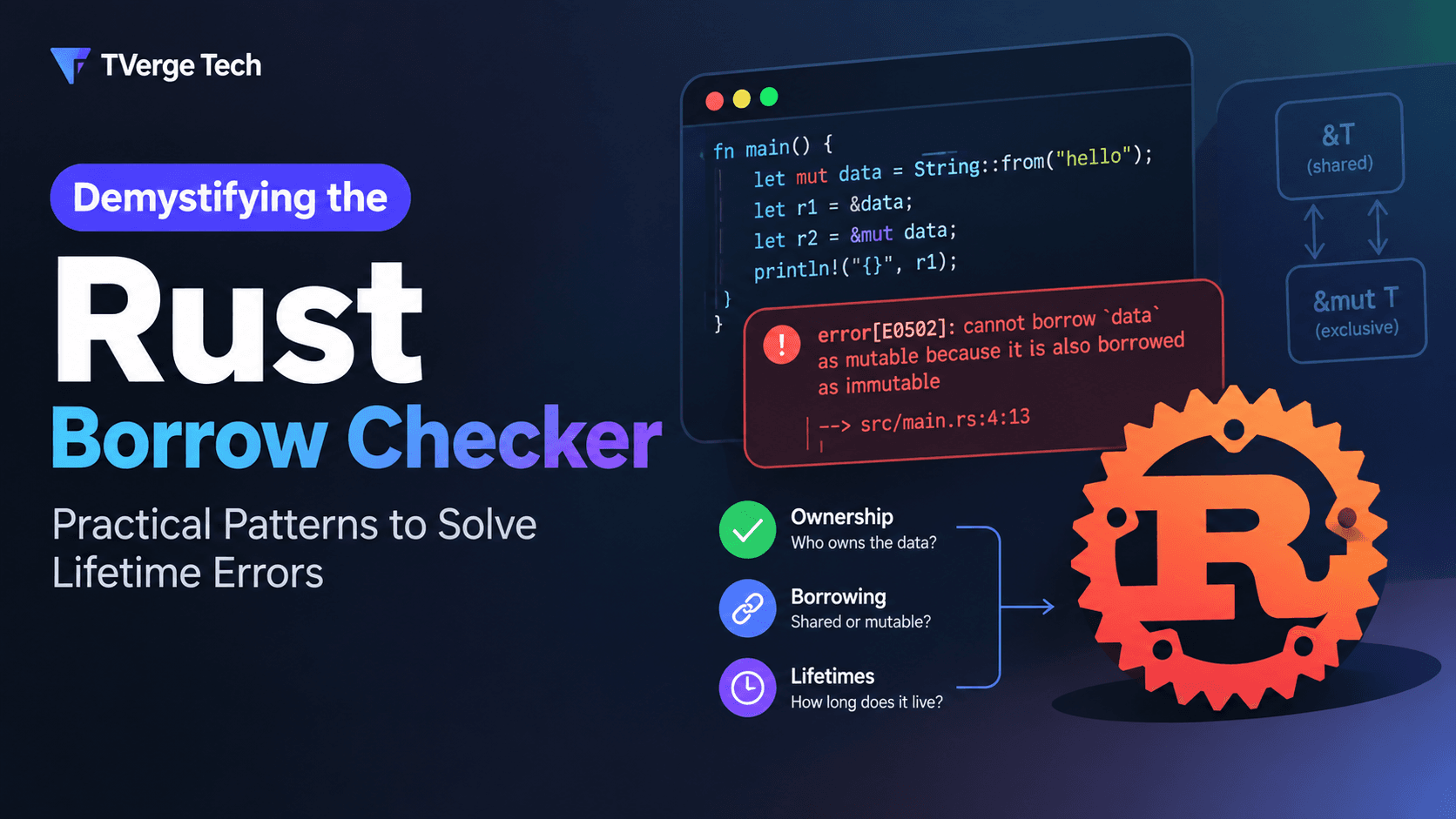
3Demystifying the Rust Borrow Checker: Fix Lifetime Errors Fast