Advanced TypeScript: Moving Beyond any to Strict Mapped Types
If you have shipped TypeScript for more than a few months, you already know the guilty feeling of typing any just to make a red squiggle disappear. It works. It also quietly turns off the compiler for everything downstream of that variable, which defeats the entire reason your team adopted TypeScript in the first place.
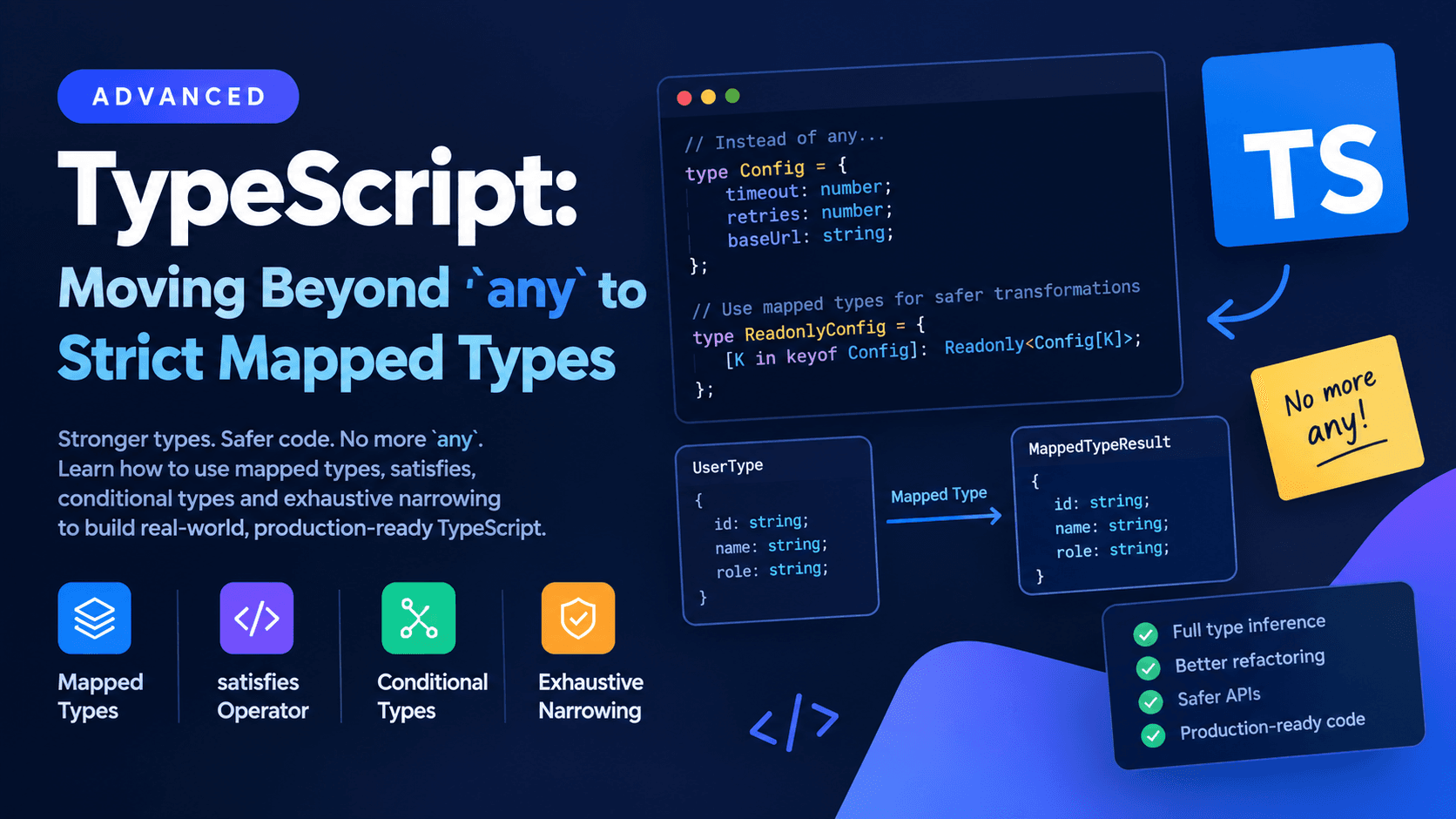
The good news is that the type system has matured well past the point where any is ever really necessary. Between mapped types, the satisfies operator, conditional types, and disciplined exhaustive narrowing, you can model almost any real-world API surface — configuration objects, event buses, form validators, API clients — with full inference and zero unsafe escape hatches.
This tutorial walks through those four tools in depth, with runnable examples, and finishes by combining all of them into one realistic, production-style pattern.
Why any Quietly Breaks Your Type System
any is not a type in the normal sense — it is an instruction to the compiler to stop checking. The moment a value is typed (or inferred) as any, that "infection" spreads: every property access, every function call, every assignment involving that value also becomes any, silently, with no warning.
function getConfig(): any {
  return JSON.parse(localStorage.getItem("config") ?? "{}");
}

const config = getConfig();
config.timeout.toUpperCase(); // compiles fine, crashes at runtime
unknown is the type-safe counterpart: it accepts anything, but forces you to narrow before you can use it. Reaching for unknown plus proper narrowing, instead of any, is the single highest-leverage habit you can build — and it's the foundation everything else in this article builds on.
The rest of this tutorial assumes you've already made that switch and are ready to go further: modeling shapes precisely with mapped types, preserving literal inference with satisfies, deriving types from other types with conditional types, and closing every remaining gap with exhaustive narrowing.
Mapped Types: The Foundation of Type-Level Transformations
A mapped type builds a new object type by iterating over the keys of an existing one. This is how TypeScript's built-in utility types like Partial<T>, Readonly<T>, and Record<K, T> are actually implemented — they aren't compiler magic, they're ordinary mapped types you could write yourself.
type Readonly<T> = {
  readonly [K in keyof T]: T[K];
};

type Partial<T> = {
  [K in keyof T]?: T[K];
};
The [K in keyof T] syntax reads as "for each key K in the keys of T." You can add or strip modifiers (readonly, ?) with + and - prefixes:
type User = {
  readonly id: string;
  name: string;
  email?: string;
};

// Strip readonly and make every property required
type MutableRequiredUser = {
  -readonly [K in keyof User]-?: User[K];
};
Key Remapping with as
TypeScript also lets you rename keys during the mapping, which is what makes mapped types genuinely powerful for building strict, purpose-built APIs rather than just cloning shapes:
type EventHandlers<T> = {
  [K in keyof T as `on${Capitalize<string & K>}`]: (payload: T[K]) => void;
};

type FormEvents = {
  submit: { values: Record<string, string> };
  cancel: undefined;
};

type FormHandlers = EventHandlers<FormEvents>;
// {
//   onSubmit: (payload: { values: Record<string, string> }) => void;
//   onCancel: (payload: undefined) => void;
// }
This pattern — deriving a whole handler map from a single source-of-truth type — eliminates an entire class of drift bugs where the handler map and the event map slowly fall out of sync.
The official TypeScript Handbook has a thorough reference on this syntax, including filtering keys out entirely with never: Mapped Types — TypeScript Handbook.
The satisfies Operator: Type-Safety Without Losing Inference
Before TypeScript 4.9, you had exactly two ways to check an object literal against a type, and both had a real cost.
Type annotation widens everything to the declared type, so you lose the specific literal information:
type RouteConfig = Record<string, { path: string; auth: boolean }>;

const routes: RouteConfig = {
  home: { path: "/", auth: false },
  admin: { path: "/admin", auth: true },
};

routes.home.path; // type is string, not "/"
routes.blog;      // no error — TypeScript doesn't know "blog" doesn't exist
Type assertion (as) keeps the literal shape but turns off checking entirely — the compiler trusts you without verifying anything:
const routes = {
  home: { path: "/", auth: false },
  admin: { path: "/admin", auth: true },
} as RouteConfig; // no validation happens here at all
satisfies gives you both properties at once: it validates the literal against the constraint, but the inferred type stays as narrow as the literal itself.
const routes = {
  home: { path: "/", auth: false },
  admin: { path: "/admin", auth: true },
} satisfies RouteConfig;

routes.home.path; // type is "/" — the literal, not string
routes.blog;      // Error: Property 'blog' does not exist
This is especially valuable for configuration objects, theme tokens, and API route tables — anywhere you want compile-time validation against a shape while keeping the precision needed for autocomplete and downstream literal-type inference. The mechanism is documented directly by the TypeScript team: The satisfies Operator — TypeScript 4.9 Release Notes.
A good rule of thumb: reach for satisfies whenever you're tempted to reach for as. If the compiler can actually verify the value is a valid representative of the type, let it — that's the whole point of as existing being unnecessary in the first place.
Conditional Types: Type-Level If/Else
A conditional type evaluates one of two branches depending on whether a type is assignable to another, using syntax that mirrors a ternary expression:
type IsString<T> = T extends string ? true : false;

type A = IsString<"hello">; // true
type B = IsString<42>;      // false
That looks trivial on its own, but conditional types become the backbone of real type-level logic once combined with two additional pieces: distribution over unions and the infer keyword.
Distributive Conditional Types
When the checked type is a naked type parameter, a conditional type distributes over union members automatically:
type ToArray<T> = T extends unknown ? T[] : never;

type Result = ToArray<string | number>; // string[] | number[]
This is why Exclude<T, U> and Extract<T, U> — both built on this exact pattern — work member-by-member across a union instead of treating the union as one opaque blob.
Extracting Types with infer
infer lets you capture a type from within a structural match and reuse it in the true branch. This is how utility types like ReturnType<T> and Awaited<T> are implemented:
type UnwrapPromise<T> = T extends Promise<infer U> ? U : T;

type A = UnwrapPromise<Promise<string>>; // string
type B = UnwrapPromise<number>;          // number

type FirstArg<T> = T extends (arg: infer A, ...rest: any[]) => any ? A : never;

type Handler = (event: MouseEvent, ctx: string) => void;
type EventArg = FirstArg<Handler>; // MouseEvent
Conditional types let you derive types instead of hand-maintaining parallel ones, which is exactly the kind of drift-elimination that mapped types give you for object shapes. The official reference covers distribution, infer, and nested conditional chains in detail: Conditional Types — TypeScript Handbook.
Combining Mapped and Conditional Types for Strict APIs
The real payoff shows up when mapped types and conditional types are used together — you can transform a shape and branch on the type of each property while doing it.
A common real-world need is a "deep" version of Readonly or Partial that recurses into nested objects instead of only affecting the top level:
type DeepReadonly<T> = T extends object
  ? { readonly [K in keyof T]: DeepReadonly<T[K]> }
  : T;

interface Settings {
  theme: {
    colors: { primary: string; secondary: string };
    darkMode: boolean;
  };
  version: number;
}

type FrozenSettings = DeepReadonly<Settings>;
// Every nested object, all the way down, is readonly.
Another practical pattern: filtering an object type down to only the keys whose values match a condition, by mapping unwanted keys to never and letting TypeScript drop them:
type FunctionKeys<T> = {
  [K in keyof T as T[K] extends (...args: any[]) => any ? K : never]: T[K];
};

interface Store {
  count: number;
  increment(): void;
  reset(): void;
}

type StoreActions = FunctionKeys<Store>;
// { increment(): void; reset(): void }  — "count" is gone entirely
This is a meaningfully different, and stricter, technique than Pick<T, K>: you don't need to know the key names in advance, because the condition does the selecting for you. It's the kind of type you'd reach for when generating a strict "actions" interface from a store shape, or splitting a props type into "data" props versus "handler" props automatically.
Exhaustive Type Narrowing: Eliminating the Last any
Mapped and conditional types handle shapes. Narrowing handles values — making sure that by the time you act on a variable, TypeScript actually knows which specific member of a union it is.
The cleanest foundation for narrowing is a discriminated union: a set of object types that share a common literal property (the "discriminant") you can switch on.
type NetworkState =
  | { status: "idle" }
  | { status: "loading" }
  | { status: "success"; data: string[] }
  | { status: "error"; message: string };

function render(state: NetworkState): string {
  switch (state.status) {
    case "idle":
      return "Waiting to start";
    case "loading":
      return "Loading…";
    case "success":
      return `Loaded ${state.data.length} items`;
    case "error":
      return `Failed: ${state.message}`;
  }
}
Inside each case, TypeScript narrows state to exactly the matching member — state.data is only accessible in the success branch, and state.message only in error. No casts, no any, no runtime checks beyond the switch itself.
Making Narrowing Exhaustive
The switch above only feels safe. If someone adds a "cancelled" status to NetworkState next quarter and forgets to update this function, it will silently fall through and return undefined at runtime, with no compiler warning. Exhaustiveness checking closes that gap using the never type:
function assertNever(value: never): never {
  throw new Error(`Unhandled case: ${JSON.stringify(value)}`);
}

function render(state: NetworkState): string {
  switch (state.status) {
    case "idle":
      return "Waiting to start";
    case "loading":
      return "Loading…";
    case "success":
      return `Loaded ${state.data.length} items`;
    case "error":
      return `Failed: ${state.message}`;
    default:
      return assertNever(state); // compile error if a case is missing
  }
}
Once every named case is handled, state in the default branch has been narrowed to never — the type with no possible values — so it's assignable to the never parameter of assertNever. If a new union member is added later and a case is missed, state in default is no longer never, and the assignment becomes a compile-time error instead of a silent runtime gap. This single pattern is arguably the highest-value narrowing technique in the language, because it turns "did we forget a case" from a code-review question into a build failure.
The Handbook's narrowing chapter covers discriminated unions, type predicates (value is T), and the in and typeof guards that feed into this pattern: Narrowing — TypeScript Handbook.
Putting It All Together: A Strict, Type-Safe Form Validator
Here is a compact example combining all four techniques — mapped types, satisfies, conditional types, and exhaustive narrowing — into something close to what you'd actually ship.
// 1. Source-of-truth field definitions
type FieldSchema =
  | { kind: "text"; minLength?: number }
  | { kind: "number"; min?: number; max?: number }
  | { kind: "checkbox" };

// 2. Conditional type: derive the runtime value type from the field kind
type FieldValue<F extends FieldSchema> = F extends { kind: "text" }
  ? string
  : F extends { kind: "number" }
  ? number
  : F extends { kind: "checkbox" }
  ? boolean
  : never;

// 3. Mapped type: derive a values object from a schema object
type FormValues<Schema extends Record<string, FieldSchema>> = {
  [K in keyof Schema]: FieldValue<Schema[K]>;
};

// 4. `satisfies`: validate the schema shape while keeping literal inference
const signupSchema = {
  email: { kind: "text", minLength: 5 },
  age: { kind: "number", min: 13 },
  acceptedTerms: { kind: "checkbox" },
} satisfies Record<string, FieldSchema>;

type SignupValues = FormValues<typeof signupSchema>;
// { email: string; age: number; acceptedTerms: boolean }

// 5. Exhaustive narrowing: validate a single field at runtime
function validateField(field: FieldSchema, value: unknown): string | null {
  switch (field.kind) {
    case "text":
      if (typeof value !== "string") return "Expected text";
      if (field.minLength && value.length < field.minLength) return "Too short";
      return null;
    case "number":
      if (typeof value !== "number") return "Expected a number";
      if (field.min !== undefined && value < field.min) return "Too low";
      if (field.max !== undefined && value > field.max) return "Too high";
      return null;
    case "checkbox":
      if (typeof value !== "boolean") return "Expected true or false";
      return null;
    default:
      return assertNever(field);
  }
}
Notice that SignupValues was never hand-written — it was fully derived from signupSchema. Change the schema, and the values type, the validator's exhaustiveness check, and every consumer of SignupValues update automatically. This is the actual goal of moving past any: not just silencing errors, but making the compiler do the bookkeeping so a single edit can't quietly desynchronize your codebase.
Common Pitfalls and When to Ease Off
- Runaway conditional recursion. Deeply recursive conditional types (like
DeepReadonlyabove) can slow down the compiler on very large or circular structures. Add a depth limit or a base case if you seetscperformance degrade on a large codebase. satisfiesisn't a replacement for runtime validation. It only checks literals you write in your source code. Data coming fromfetch,JSON.parse, or user input is stillunknownat the type level and needs an actual runtime check (or a schema library) before you can trust it.- Don't over-abstract mapped types for one-off shapes. If a type is used in exactly one place and will never be derived from elsewhere, a plain interface is more readable than a clever mapped type. Reach for these tools when they eliminate duplication or drift, not to show off type-level cleverness.
anystill has a narrow, legitimate use. Third-party type definitions that are outright wrong, or a genuinely untypeable escape hatch at a system boundary, are reasonable places for a well-commentedany— just keep it contained with aneslint-disablecomment explaining why, rather than letting it leak into your own domain types.
Conclusion
any isn't dangerous because it's convenient — it's dangerous because it stops the compiler from doing the one job you're paying it to do. Mapped types let you derive one shape from another instead of maintaining duplicates by hand. satisfies gives you validation without sacrificing inference. Conditional types let you branch on type structure the same way you'd branch on runtime values. And exhaustive narrowing turns "we forgot a case" into a compile error instead of a production incident.
None of these are exotic features — they're all documented, stable parts of the language you're already using. The only real barrier to using them is habit. Once you make deriving types the default instead of writing any to move on, the rest of this pattern tends to fall into place on its own.
Frequently Asked Questions
Is satisfies a runtime operator? No. satisfies is purely a compile-time check — it's erased entirely and has zero effect on the emitted JavaScript. It only changes how TypeScript validates and infers the expression it's attached to.
Should I always prefer unknown over any? For anything entering your codebase from outside the type system — API responses, JSON.parse, user input — yes. unknown forces a narrowing step before the value can be used, which is exactly the safety any throws away.
Do conditional types affect the compiled JavaScript output? No. All TypeScript types, including mapped and conditional types, are stripped during compilation. They exist purely to catch mistakes before your code ever runs.
If you're cleaning up other legacy JavaScript patterns alongside your type-safety pass, our guide on refactoring reduce()-based grouping to Object.groupBy() and Map.groupBy() covers another common source of untyped, error-prone utility code. And if your TypeScript app is a long-running Node.js service, it's worth pairing strict typing with a look at how memory leaks actually form in Node.js applications — type safety prevents one class of production bug, not all of them.