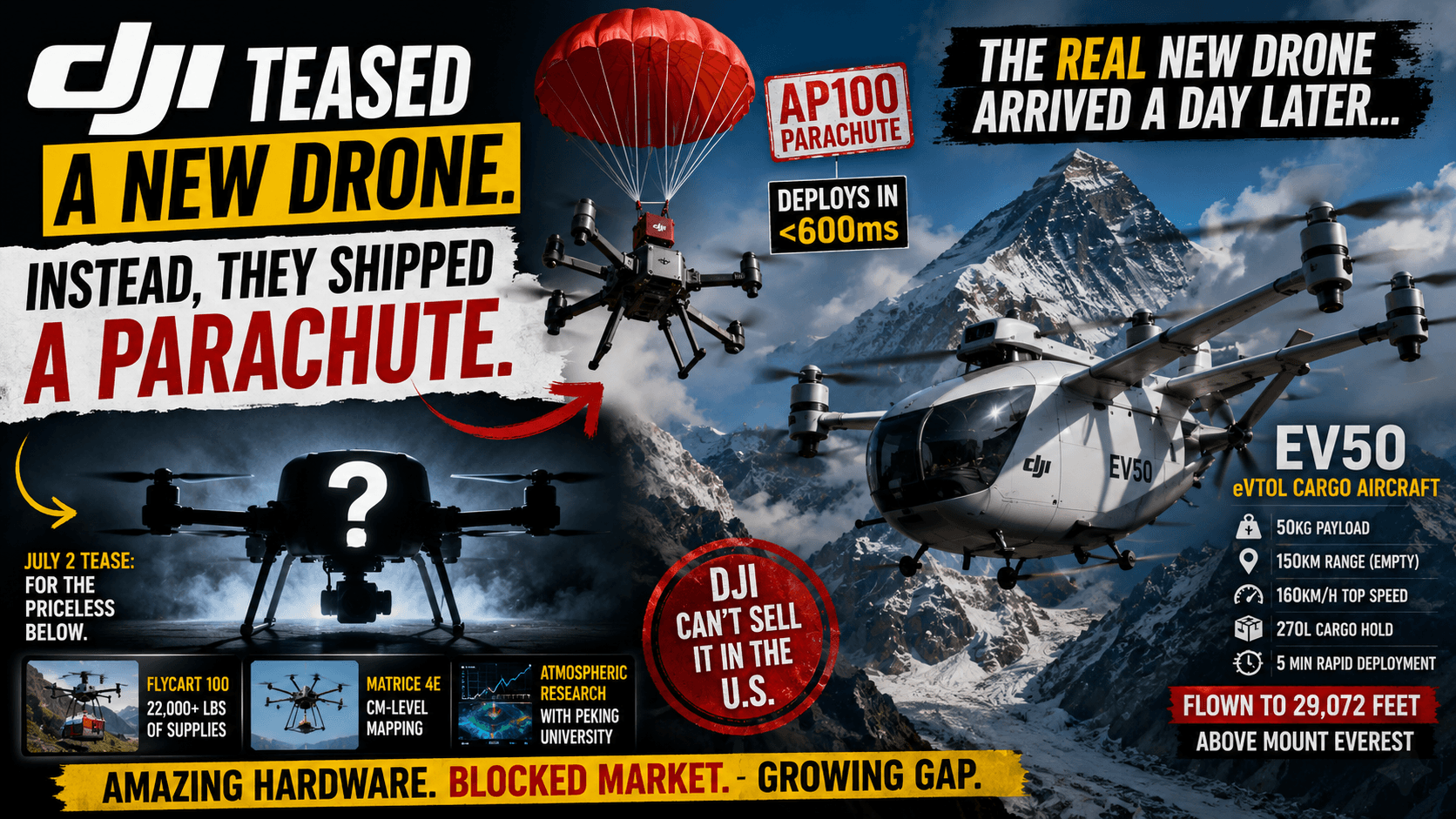
On July 2, 2026, DJI Enterprise posted a teaser under the tagline "For the Priceless Below." The image: a darkened silhouette, tall landing gear, a belly-mounted gimbal payload, something that looked like an FPV camera pod on top. The reveal was set for July 8, 8 AM EDT. Everyone who covers this industry looked at that outline and reached the same conclusion.
They were wrong.
What the silhouette was supposed to mean
The Matrice 30 — DJI's standard-issue quadcopter for search-and-rescue teams and public-safety agencies, and the airframe most US fire departments fly — hadn't been replaced in four years. A public-safety tagline, a mid-size quadcopter shape, and an overdue product cycle pointed at exactly one thing.
DroneXL's editor previewed the July 8 event by naming the aircraft outright: everything — silhouette, branding, timing — pointed at "the long-overdue successor to the Matrice 30 series." Reboot Hub's coverage independently reached the identical read. It wasn't a fringe guess. It was the consensus.
What actually shipped
DJI unveiled the AP100 Parachute — a rear-mounted safety accessory for the Matrice 400, not a new aircraft at all.
"I called this one wrong, and I would rather own that than bury it." — DroneXL, after the reveal
That's a rare thing in tech coverage: a publication naming its own miss in print, same day, no hedge. It's also the most useful evidence in this story, because it confirms the "everyone expected a drone" framing wasn't hype-chasing — it was the reasonable read of the available signal, and it was still wrong.
| Expected | Delivered |
|---|---|
| Matrice 30 successor (new airframe) | AP100 Parachute (accessory) |
| Public-safety / SAR positioning | European commercial-compliance positioning |
| US fire/police relevance | No FAA mention at all |
| New product category | Add-on for an existing aircraft (Matrice 400) |
What the parachute actually does
Specs, for the part that got overshadowed by the surprise:
- Weight: ~935 g, rear-mounted via the E-Port V2 connector
- Response time: deploys in under 600 ms
- Descent rate: slows the aircraft to below 5 m/s
- Redundancy: independent power, its own flight controller and IMU, and its own comms link — meaning it can still fire even if the Matrice 400's battery, flight controller, or control link has failed completely
- Minimum deployment altitude: 30 m, below which the canopy may not fully inflate
- Single-use: the pyrotechnic gas generator requires full replacement after any deployment; DJI recommends retirement three years after activation regardless of self-check status
The part that matters more than the hardware is what it unlocks: paired with the AP100, the Matrice 400 meets EASA C5/C6 and UK CAA UK5/UK6 operational safety requirements — the classification threshold that separates demo flights from routine flights over crowds and beyond-visual-line-of-sight operations in Europe and the UK. C6/UK6 specifically requires the factory-configured Matrice 400 (C6) Combo; existing M400 owners can retrofit to C5/UK5 or send units back to DJI for retrospective class-marking.
Why "just a parachute" might be the sharper move
A new airframe starts its EASA and UK CAA certification process from zero. The Matrice 400 is already a platform operators own, trust, and have built workflows around. Converting it into a class-marked aircraft — rather than asking European and UK enterprise crews to requalify an entirely new one — is a faster route to legally flying over people today, which is the actual bottleneck for public-safety and urban BVLOS operations, not raw capability.
DroneXL's reassessment after the reveal put it plainly: for a European utility crew or urban survey operation, class marking is the product — arguably worth more operationally than a new airframe would have been.
The part that didn't happen
That reframe doesn't erase the original miss, and it doesn't answer the question that started this: the Matrice 30 still hasn't been replaced. Nothing about the AP100 announcement addressed that gap, and DJI gave no indication of what — if anything — comes next behind the "Priceless Below" banner.
There's also a geography problem baked into the choice itself. DJI's December 2025 addition to the FCC's Covered List means new DJI models can't receive the equipment authorization needed for legal sale in the US. Whether the "expected" Matrice 30 successor would have cleared that bar was already in doubt before July 8. What DJI shipped instead sidesteps the question entirely — the AP100's entire value proposition runs through EASA and UK CAA paperwork, with no FAA mention anywhere in the announcement.
Read together, that's not a company that forgot about US public safety. It's a company that picked the market where a compliance accessory could ship a real capability this quarter, over the market where a new airframe might not have been legally sellable at all.
The takeaway
The "new DJI drone" that public-safety operators, drone journalists, and fire departments spent a week anticipating wasn't a drone. It was 935 grams of pyrotechnics and redundant electronics solving a paperwork problem — for a market DJI can actually still ship to. The Matrice 30 successor everyone wanted is still out there, unannounced, and now harder to guess the timing on should be — a compliance win dressed as a product miss.
Distinct from the prior two pieces: this opens on a mystery-reveal (withhold the answer, then flip it), runs a prediction-vs-outcome narrative model anchored by a competing outlet's own on-record correction, and closes on a strategic-implication note rather than a metaphor or an open question. The twist — the "drone" everyone expected turned out not to be a drone at all — is real reporting, not a framing device I invented.